



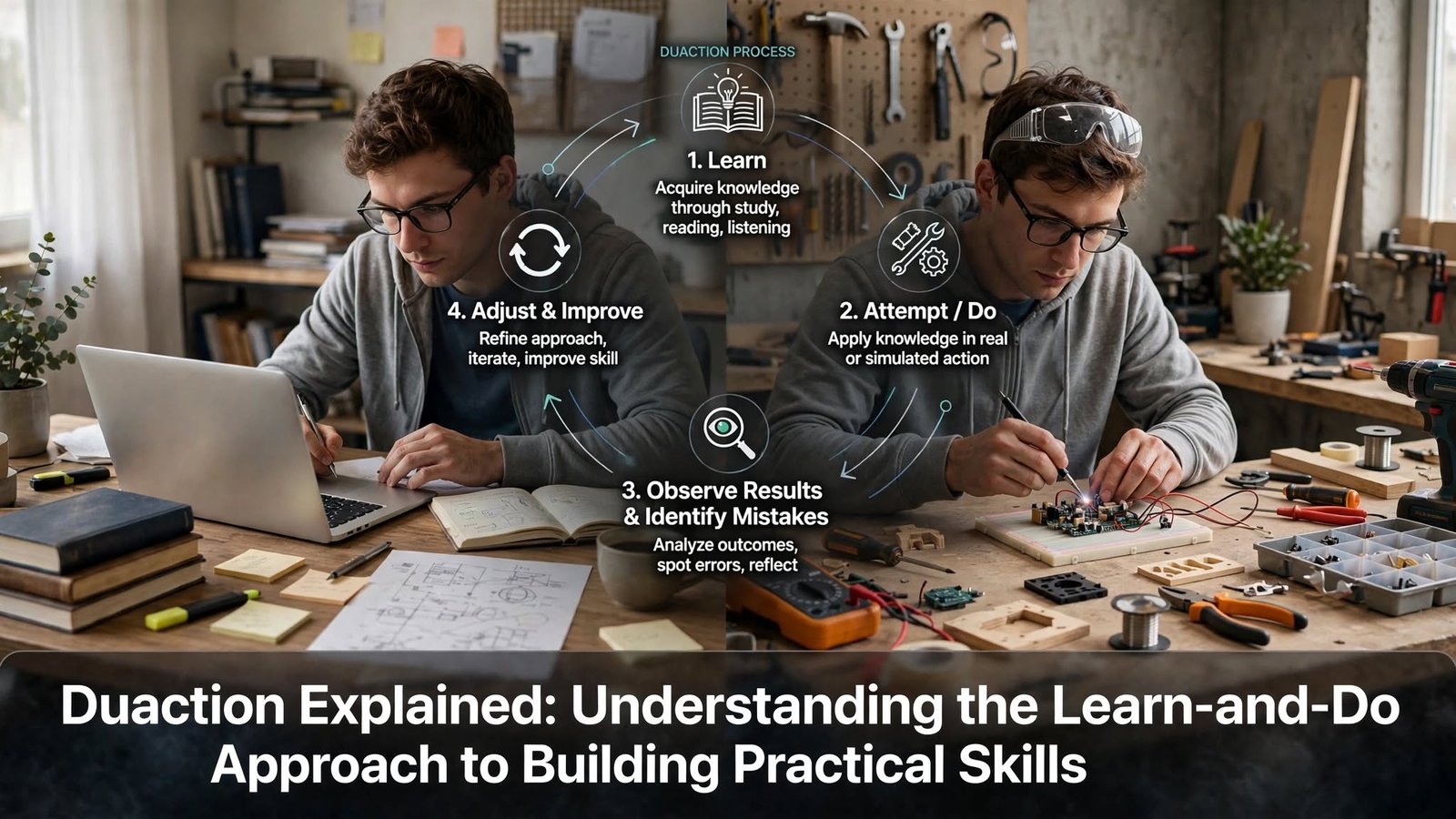
Learning is often described as the process of gaining knowledge, while doing refers to putting that knowledge into practice. Duaction can be understood as a concept that brings these two ideas together, emphasizing the connection between learning and action.
Instead of treating education and practical experience as completely separate activities, a learn-and-do approach encourages people to apply new information while they are still developing their understanding.
This approach can be useful in many areas, including education, professional development, technology, creative work, entrepreneurship, and everyday problem-solving. The basic idea is straightforward: people can often understand a subject more effectively when they have opportunities to practice what they learn.
What Is Duaction?
Duaction is a term that can be used to describe an approach centered on learning through action and applying knowledge through practice. The concept combines the idea of acquiring information with actively using that information in real or simulated situations.
Traditional learning can sometimes focus heavily on reading, watching demonstrations, listening to explanations, or memorizing information. While these activities can provide an important foundation, they do not always provide enough opportunity to develop practical ability.
A learn-and-do model adds an active component. Instead of simply learning how something works, the learner attempts to use that knowledge, observes the results, identifies mistakes, and adjusts their approach.
The Connection Between Learning and Doing
Knowledge and practical ability are closely connected, but they are not necessarily the same thing. Someone may understand the theory behind a particular task without having enough experience to perform it confidently.
For example, reading about photography can explain exposure, shutter speed, aperture, and composition. However, actually taking photographs provides opportunities to see how those concepts behave under different conditions.
The same principle applies to programming, cooking, writing, design, business, and many other activities. Practical experience creates situations where abstract information becomes more concrete.
Why Practical Learning Matters
Practical learning gives people opportunities to test their understanding. When learners attempt a task themselves, they may discover gaps in their knowledge that were not obvious while simply reading or listening.
Making mistakes can also become part of the learning process. Instead of treating every mistake as failure, a learn-and-do approach can use mistakes as information about what needs to be changed or understood more clearly.
This creates a continuous relationship between knowledge and experience. The learner studies a concept, applies it, observes the outcome, and then uses that experience to improve future attempts.
Learning by Doing in Education
Educational environments can incorporate learn-and-do principles in many different ways. Students might complete experiments, projects, presentations, simulations, practical assignments, or collaborative activities.
These activities allow learners to move beyond theoretical explanations and interact directly with the subject.
For example, a science student may understand a scientific principle from a textbook but gain a different level of understanding by conducting an experiment. The practical activity provides an opportunity to observe results and connect them with the underlying theory.
Duaction and Skill Development
Skill development usually requires repetition and feedback. Reading instructions can introduce a skill, but performing the skill repeatedly helps develop familiarity and control.
Consider someone learning graphic design. Studying design principles can teach concepts such as typography, spacing, contrast, and visual hierarchy.
Creating actual designs provides a practical environment where those principles can be tested. Over time, the learner can compare different approaches, recognize common problems, and develop a more refined understanding of design.
The Role of Practice
Practice is one of the central components of a learn-and-do approach. Repeatedly performing a task allows learners to become more comfortable with the process and identify areas that require improvement.
However, practice is most useful when it is intentional. Simply repeating the same action without examining the results may not lead to meaningful improvement.
Effective practice involves paying attention to outcomes and making adjustments. Each attempt can become an opportunity to refine technique and strengthen understanding.
Feedback and Continuous Improvement
Feedback is another important part of practical learning. After completing a task, learners can evaluate what worked, what did not work, and what could be improved.
Feedback can come from teachers, mentors, colleagues, customers, peers, or the learner’s own observations.
The goal is not simply to identify mistakes. Constructive feedback provides information that can guide the next attempt and make the learning process more focused.
Duaction in Professional Development
The learn-and-do approach can also be valuable in the workplace. Employees often need to develop new skills while dealing with real responsibilities and changing requirements.
Training programs that combine instruction with practical exercises can help employees understand how concepts apply to their actual work.
For example, someone learning a new software system may benefit from using the software during training rather than only watching demonstrations. Performing realistic tasks can make the learning experience more relevant.
Learning Through Projects
Projects provide a natural environment for combining knowledge and action. A project usually requires a person to understand a goal, make decisions, apply skills, solve problems, and evaluate results.
This makes project-based learning particularly compatible with a learn-and-do philosophy.
A person learning web development, for example, could study HTML, CSS, and JavaScript before building a small website. The project creates opportunities to apply each concept and encounter practical challenges that may not appear in theoretical lessons.
Duaction and Technology
Technology has made practical learning more accessible. Online courses, interactive tutorials, simulations, coding environments, design software, and digital collaboration platforms can allow people to practice skills from almost anywhere.
Many digital learning platforms combine explanations with exercises, quizzes, demonstrations, and projects. This structure allows users to move between learning new information and applying it.
Technology can therefore support a learning cycle in which information is introduced, practiced, evaluated, and refined.
Self-Directed Learning
A learn-and-do approach can also support independent learners. People do not always need to follow a traditional classroom structure to develop useful skills.
Someone interested in photography, programming, writing, marketing, or another subject can identify a specific goal, learn the relevant fundamentals, and begin practicing through small projects.
This approach gives learners greater control over the pace and direction of their development. It can also make learning more closely connected to personal interests and practical goals.
Starting Small
One advantage of learning through action is that learners do not necessarily need to begin with a large or complicated project. Small tasks can provide a manageable starting point.
For example, someone learning video editing might begin by creating a short one-minute video rather than immediately attempting a feature-length project.
Small projects provide opportunities to practice individual skills without creating unnecessary complexity. As confidence and experience increase, the learner can gradually take on more challenging tasks.
Learning From Mistakes
Mistakes are a natural part of practical skill development. When learners perform an unfamiliar task, they may encounter problems that could not have been predicted from theory alone.
These mistakes can provide useful information. By examining what went wrong, the learner can develop a better understanding of the process and adjust their approach.
A productive learn-and-do environment therefore treats mistakes as opportunities for analysis rather than simply as negative outcomes.
Balancing Theory and Practice
Practical experience is valuable, but theory remains important. Without an understanding of fundamental concepts, learners may repeat actions without knowing why they work.
A balanced approach combines both elements. Theory provides explanations and frameworks, while practice demonstrates how those ideas function in real situations.
The relationship can be continuous rather than sequential. A learner might study a concept, practice it, encounter a problem, return to the theory, and then try again with a better understanding.
Duaction in Creative Fields
Creative disciplines can particularly benefit from a learn-and-do approach. Writers, artists, photographers, musicians, designers, filmmakers, and other creators often develop their abilities through experimentation.
Studying the work of experienced creators can provide useful knowledge, but producing original work allows learners to develop their own techniques.
Over time, repeated creative practice can help individuals understand their strengths, recognize weaknesses, and discover approaches that suit their goals.
Duaction and Entrepreneurship
Entrepreneurship is another area where learning and action frequently overlap. Business concepts can be studied through books, courses, research, and case studies, but running an actual project introduces practical challenges.
Entrepreneurs may need to communicate with customers, test ideas, manage resources, evaluate feedback, and adjust their plans.
This makes entrepreneurship a natural environment for experiential learning. Each action can generate information that influences the next decision.
Creating a Personal Learn-and-Do Routine
A person can incorporate this approach into everyday learning by connecting each new topic with a practical activity. After studying a concept, the learner can ask how it could be tested or applied.
The activity does not have to be complicated. A short exercise, small project, experiment, or real-world task may be enough to reinforce the idea.
Keeping notes about results can also help. Recording what was learned, what went wrong, and what should be attempted next creates a simple feedback loop.
Challenges of the Learn-and-Do Approach
Although practical learning has many advantages, it can also present challenges. Beginners may become frustrated when their first attempts do not produce the expected results.
Some skills also require a substantial theoretical foundation before meaningful practice becomes possible. In technical or specialized fields, incorrect practice can reinforce misunderstandings if the learner receives no feedback.
For this reason, practical activities work best when combined with reliable information, clear goals, appropriate guidance, and opportunities for reflection.
The Future of Practical Learning
Education and professional training continue to place greater emphasis on skills that can be applied in real situations. As technology develops, learners have access to increasingly sophisticated simulations, interactive tools, and digital environments.
These resources can make it easier to experiment without requiring expensive equipment or traditional classroom settings.
The broader trend toward experiential learning suggests that the connection between knowledge and action will remain important across education, employment, and personal development.
Conclusion
Duaction can be understood as a learn-and-do approach that connects knowledge with practical action. Rather than treating learning as something that happens only through reading or instruction, it emphasizes applying information, practicing skills, receiving feedback, and improving through experience.
The approach can be applied across many areas, from education and professional development to creative projects, technology, and entrepreneurship.
By combining theory with purposeful practice, learners can create a continuous cycle of understanding, action, reflection, and improvement. This makes the learn-and-do concept a useful framework for anyone seeking to turn knowledge into practical skills.
