



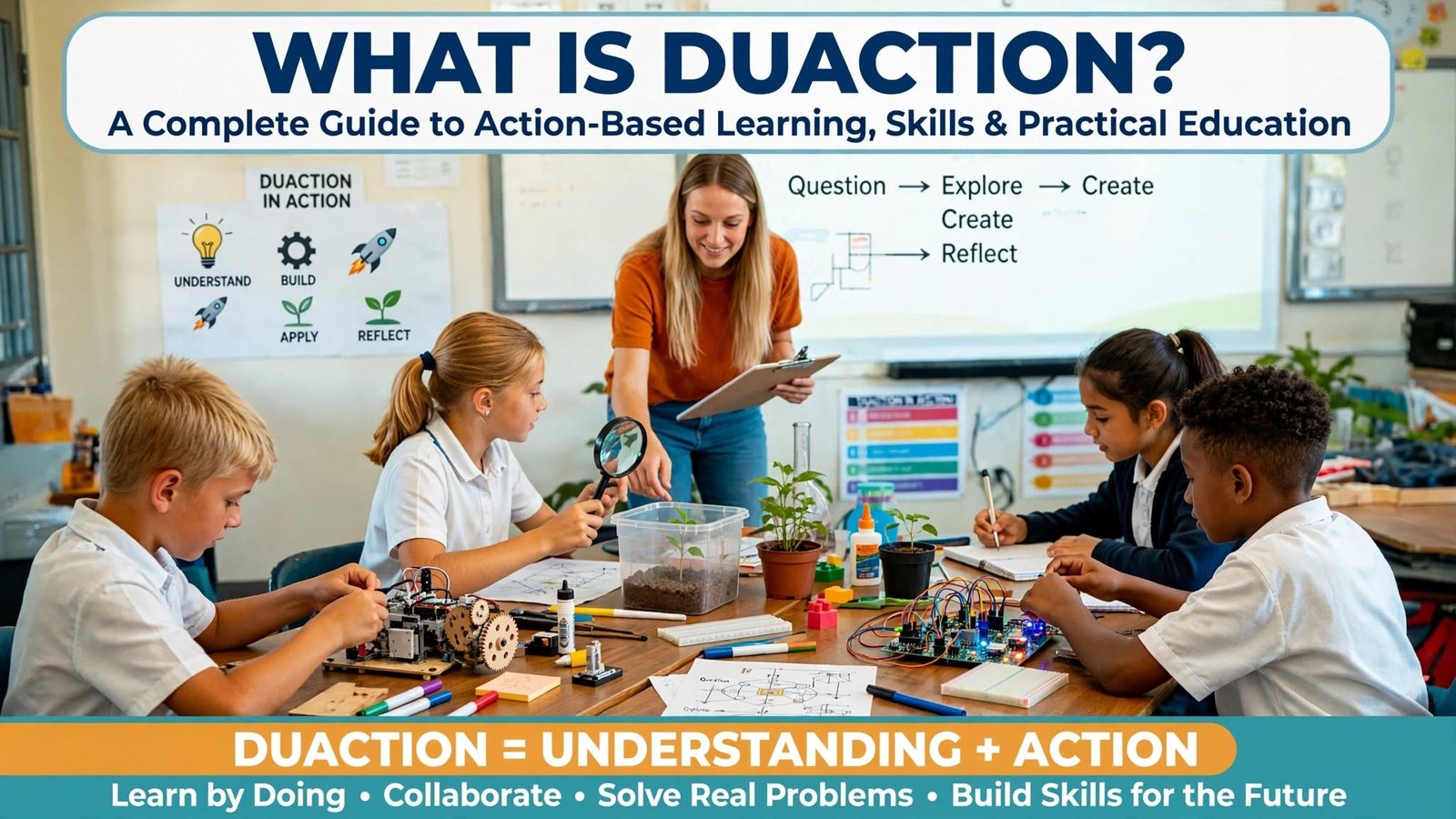
What Is Duaction?
Duaction is an approach to learning that combines understanding with action. Instead of treating education as the process of collecting information and remembering facts, duaction emphasizes learning by doing, practicing, experimenting, applying ideas, and reflecting on real experiences.
In simple terms, duaction means turning knowledge into action so that learning becomes practical, useful, and easier to apply in everyday situations. A person does not simply learn what something is or how it works; they also practice using that knowledge in a meaningful context.
The idea is especially relevant in a world where knowing something is not always enough. Someone may understand the principles of communication but struggle to communicate effectively, or study the theory of entrepreneurship without knowing how to develop and test an actual business idea.
Duaction addresses this gap by connecting learning with experience. The learner moves between understanding a concept, putting it into practice, observing the result, and improving through feedback.
How Does Duaction Work?
Duaction generally follows a simple learning cycle: understand, act, observe, reflect, and improve. These stages do not always happen in a strict order, but together they create a more active learning experience.
First, the learner develops enough knowledge to understand the task or problem. This might involve reading, watching a demonstration, listening to an explanation, studying examples, or discussing the subject with someone who has experience.
The next step is action. Instead of stopping after gaining theoretical knowledge, the learner uses it. A student learning photography might take photographs, someone studying programming might build a small application, and a person developing public-speaking skills might actually give a presentation.
The results of that action provide new information. The learner can see what worked, what failed, and what needs to change.
Reflection then turns the experience into deeper understanding. Rather than simply repeating an activity, the learner considers why a particular result occurred and how the next attempt could be better.
Why Is Action-Based Learning Important?
Traditional education can be highly effective at developing knowledge, but knowledge alone does not automatically produce competence. Practical ability usually develops when people have opportunities to use what they know.
Action-based learning creates those opportunities. It gives learners a reason to remember information because the information is connected to a task, problem, goal, or experience.
For example, a person can memorize the rules of budgeting and still find it difficult to manage actual finances. Building a sample budget, tracking expenses, adjusting spending categories, and evaluating the results creates a different level of understanding.
The same principle applies to professional skills. Reading about leadership is useful, but leading a project, resolving a disagreement, organizing a team, and receiving feedback can reveal challenges that textbooks cannot fully reproduce.
Duaction and Practical Skills
One of the strongest applications of duaction is skills development. Practical skills require more than theoretical awareness because performance depends on repetition, judgment, timing, adaptation, and confidence.
Consider learning to cook. Reading a recipe can explain ingredients, measurements, temperatures, and techniques, but practical experience teaches additional lessons: how dough feels when properly kneaded, how quickly a pan heats, when food is actually done, and how to adjust when conditions differ from the recipe.
Duaction applies the same principle to professional and personal development. Skills become stronger when learners repeatedly move between knowledge and application.
This is particularly important for skills such as writing, coding, design, public speaking, project management, negotiation, teaching, problem-solving, and creative work. In each case, practice exposes details that passive study may leave hidden.
The Difference Between Knowing and Doing
A central idea behind duaction is the difference between theoretical knowledge and functional knowledge.
Knowing something means being able to understand, explain, recognize, or recall information. Doing something means being able to use that knowledge to accomplish a task under real or realistic conditions.
The two forms of learning support each other. Without knowledge, practice can become inefficient because the learner may not understand what they are doing or why a particular method works. Without practice, knowledge may remain disconnected from real situations.
Duaction therefore does not suggest abandoning traditional study. Instead, it gives study a practical destination.
A learner might first study the principles of effective presentations, then create slides, prepare a talk, deliver it to an audience, receive feedback, and revise the presentation. Each stage strengthens the others.
Duaction in Schools and Universities
Action-based education can be incorporated into formal education without replacing conventional academic subjects. Teachers can connect lessons with projects, experiments, simulations, fieldwork, practical assignments, group activities, and real-world problems.
A science class, for instance, can combine theoretical instruction with experiments that allow students to observe the concepts directly. A business course can involve developing a hypothetical product and researching its potential customers.
This approach can also make assessment more meaningful. Instead of evaluating students only through written examinations, educators can assess projects, demonstrations, portfolios, presentations, prototypes, experiments, and other forms of applied work.
The goal is not to make education easier. Practical learning can actually require students to think more deeply because they must make decisions and respond to unexpected problems rather than simply reproduce information.
Duaction in Workplace Learning
The workplace is naturally suited to action-based learning because many professional abilities develop through experience.
Employees can learn through supervised projects, simulations, mentoring, job rotations, practical workshops, role-playing exercises, and progressively more challenging responsibilities.
A new manager, for example, might study management principles before taking responsibility for a small project. Afterward, feedback from colleagues and supervisors can help identify areas for improvement.
This creates a continuous learning process. Instead of viewing training as something that happens only during a course, organizations can treat everyday work as an opportunity to develop capability.
Duaction and Technology
Technology can make action-based learning easier to organize and personalize. Interactive simulations, virtual laboratories, educational software, digital projects, collaborative platforms, and practice environments allow learners to experiment without always requiring access to expensive physical resources.
Technology can also shorten the distance between attempting a task and receiving feedback. A learner may submit work, identify errors, compare different approaches, and immediately try again.
Artificial intelligence can further support this process by providing explanations, simulations, practice questions, feedback, and personalized exercises. However, technology works best when it supports genuine engagement rather than replacing the learner’s effort.
The essential element of duaction is still action. A digital platform can provide an environment for practice, but meaningful learning occurs when the person actively thinks, experiments, makes decisions, and improves.
The Role of Mistakes in Duaction
Mistakes are not necessarily signs that learning has failed. In an action-based learning environment, mistakes can provide useful information about what the learner understands and where additional practice is needed.
Suppose someone is learning to write persuasive content. Their first attempt may contain unclear arguments, weak organization, or an unsuitable tone. Feedback on that attempt gives the learner specific information that can guide the next version.
This creates a productive relationship with failure. The purpose is not to make mistakes for their own sake, but to create an environment where manageable mistakes can be identified, understood, and corrected.
Over time, repeated cycles of practice and adjustment can build stronger judgment and independence.
Duaction and Critical Thinking
Action-based learning can also encourage critical thinking because real tasks rarely have perfectly defined answers.
When learners work with practical problems, they often need to decide which information matters, compare possible solutions, identify limitations, test assumptions, and adjust their approach.
For example, designing a small community project may require more than knowing project-management terminology. The learner might need to work within a budget, respond to changing requirements, communicate with different people, and decide which problems need immediate attention.
These situations encourage learners to move beyond memorization and consider how knowledge should be applied.
Benefits of Duaction
The potential benefits of duaction come from the connection between knowledge and meaningful practice. Learners can develop stronger practical competence because they repeatedly apply ideas rather than encountering them only in an abstract form.
Action-based learning can also improve problem-solving, adaptability, confidence, communication, decision-making, and independent learning. These benefits are particularly valuable when the goal is to prepare people for situations that cannot be completely predicted in advance.
Another advantage is relevance. When learners can see how an idea connects to a real task or personal goal, the material may feel more meaningful and easier to remember.
However, action-based learning is not automatically effective. Poorly designed activities can waste time or reinforce incorrect techniques. Learners still need clear explanations, appropriate guidance, useful feedback, and opportunities to reflect.
How to Apply Duaction in Everyday Life
Duaction does not require a classroom, formal course, or specialized program. It can be used whenever someone wants to develop a skill or understand a subject more deeply.
A person learning a language can practice conversations rather than studying vocabulary exclusively. Someone interested in photography can create a series of photographs around a specific theme and review the results. A person learning personal finance can create a realistic monthly budget and monitor how well it works.
The important question is simple: How can I use what I am learning?
Once that question becomes part of the learning process, study can become more purposeful. Reading or watching instructional material becomes the preparation for an activity rather than the final destination.
A Simple Duaction Learning Cycle
A practical duaction cycle can begin with a clear goal. The learner identifies what they want to be able to do rather than merely what information they want to remember.
They then learn the essential concepts and attempt a realistic task. After completing the task, they examine the result, seek feedback, identify weaknesses, and make another attempt using what they have learned.
The cycle can be repeated as many times as necessary. With each iteration, the learner moves from basic understanding toward greater fluency and independence.
This process also allows learning to become personalized. Two people can study the same subject but practice different tasks depending on their goals, experience, strengths, and areas that require improvement.
Duaction Compared With Traditional Learning
Traditional learning and duaction should not necessarily be viewed as competing systems. Effective education often combines both.
Lectures, books, explanations, demonstrations, and structured lessons can provide the conceptual foundation needed for successful practice. Action then allows learners to test and deepen that knowledge.
The difference is primarily one of emphasis. A strongly passive approach may stop once information has been delivered and recalled. A duaction-oriented approach continues until the learner has had opportunities to use the information and learn from the results.
The most effective combination may therefore be a balanced one: learn the principles, apply them, receive feedback, reflect, and return to the theory when a practical problem reveals something that needs further understanding.
Challenges and Limitations
Action-based learning also presents challenges. Practical activities can require more time, resources, supervision, and preparation than conventional instruction.
Some skills are difficult or dangerous to practice without appropriate guidance. In technical, medical, industrial, scientific, or other specialized environments, learners may need carefully controlled simulations or supervised practice before attempting real tasks.
There is also a risk of practicing incorrectly. Repetition does not automatically create expertise; repeated mistakes can become habits if learners do not receive useful feedback.
For this reason, duaction works best when action is supported by good instruction, clear goals, reflection, and constructive evaluation.
What Makes Duaction Effective?
The quality of the learning experience matters more than simply adding activities. A useful action-based task should have a clear purpose and should require the learner to apply relevant knowledge.
Feedback should arrive soon enough to influence the next attempt, and learners should have enough freedom to make decisions rather than merely follow instructions mechanically.
Reflection is equally important. Asking what happened, why it happened, what could be changed, and what should be tried next turns experience into learning.
When these elements work together, action becomes more than activity. It becomes a structured way of developing understanding and competence.
The Future of Action-Based Education
Education is increasingly expected to prepare people not only to know information but also to use it effectively. As workplaces change and technology makes information easier to access, the ability to apply knowledge, evaluate situations, collaborate, solve problems, and continue learning becomes increasingly important.
Duaction represents this broader shift toward learning that connects ideas with experience. Its underlying principle is straightforward: people often understand something more deeply when they have the opportunity to use it, examine the result, and improve.
The approach is unlikely to replace books, lectures, examinations, or theoretical study. Instead, its greatest value may come from connecting those traditional methods with purposeful practice.
Final Thoughts
Duaction can be understood as learning through the continuous connection of knowledge and action. It encourages people to move beyond simply asking, “What do I know?” and also ask, “What can I do with what I know?”
That distinction matters in education, professional development, and everyday life. Information provides a foundation, but practice reveals how that information works in real situations.
When learning includes action, feedback, reflection, and repeated improvement, education can become more practical and personally meaningful. The result is not simply a person who knows more, but a learner who is increasingly capable of turning knowledge into useful action.
