



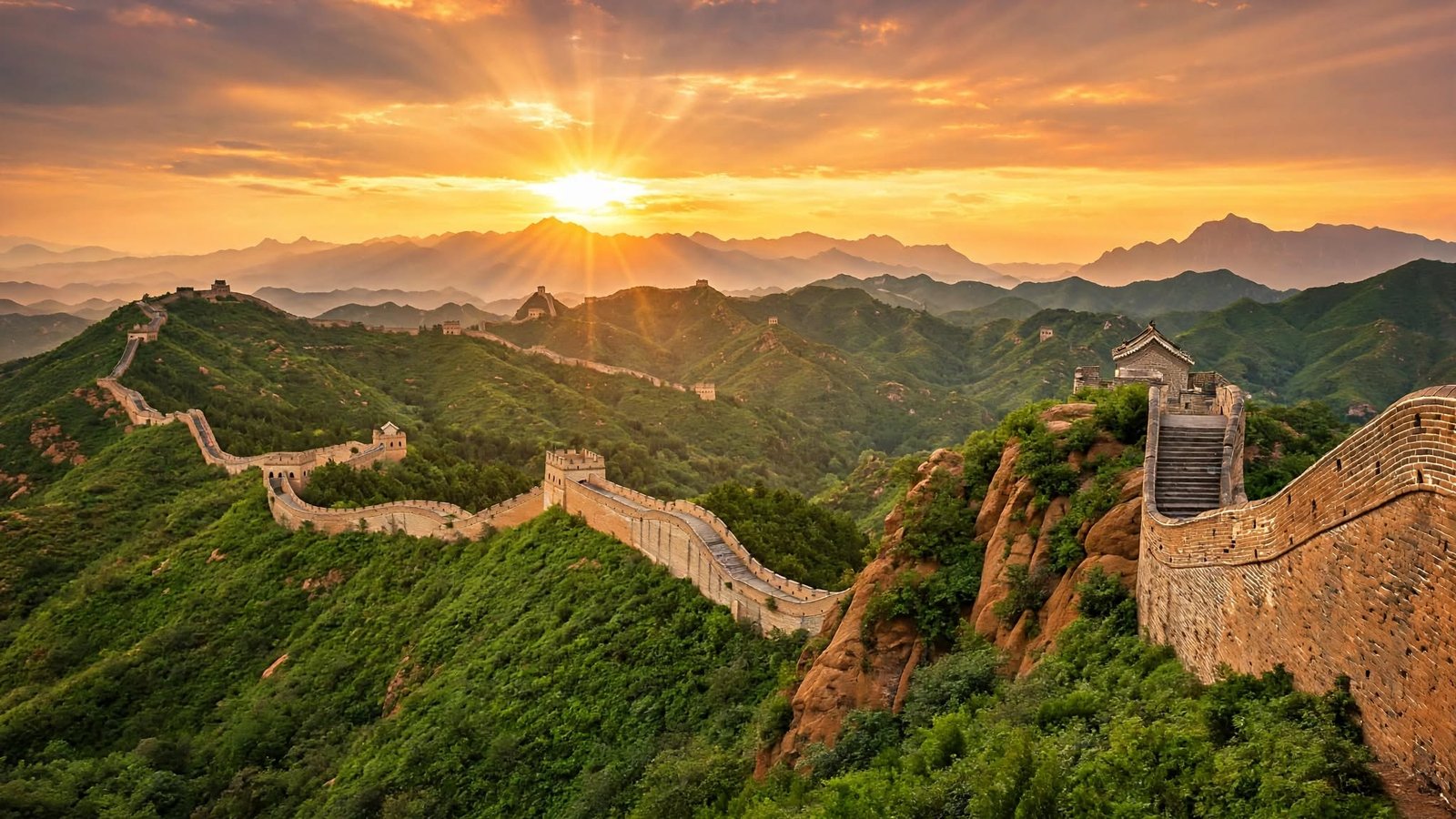
The Great Wall of China was built without modern machinery, cranes, trucks, or advanced construction equipment. Instead, ancient Chinese workers relied on human strength, simple tools, local materials, clever engineering techniques, and an impressive understanding of the natural landscape to create one of the most remarkable structures in human history.
Stretching across mountains, valleys, deserts, and grasslands, the Great Wall represents centuries of hard work, military planning, and architectural innovation. Its construction took place over many generations, with different Chinese dynasties expanding, repairing, and strengthening various sections to protect their territories from invading forces.
But how did ancient builders manage such an enormous project with the limited technology available at the time? The answer lies in their resourcefulness, practical construction methods, and ability to adapt building techniques to challenging environments.
What Is the Great Wall of China?
The Great Wall of China is an extensive network of defensive walls, watchtowers, fortresses, passes, and other military structures built across northern China. It was mainly constructed to defend Chinese territories against invasions and raids by nomadic tribes from the northern regions.
Although commonly described as one continuous wall, it is actually a collection of interconnected and separate defensive structures constructed during different historical periods. Some sections follow mountain ridges, while others cross open plains and desert landscapes.
The earliest walls appeared more than 2,000 years ago, when separate Chinese states built defensive barriers to protect their territories. Later, the Qin Dynasty connected and expanded several existing walls, creating an important foundation for what eventually became the Great Wall.
The structure reached much of its recognizable form during the Ming Dynasty (1368–1644), when extensive construction and renovation projects introduced stronger brick and stone walls, fortified gates, and sophisticated watchtowers.
Why Was the Great Wall of China Built?
The primary reason for building the Great Wall was military defense. Ancient Chinese rulers faced repeated threats from northern nomadic groups, including raids on settlements, agricultural communities, and important trade routes.
The wall helped create a defensive boundary that made surprise attacks more difficult. Its towers provided elevated positions for observing distant movements, while guarded entrances controlled access through important mountain passes and transportation routes.
However, the Great Wall served purposes beyond military protection. It also helped regulate trade, monitor movement across borders, and support the administration of frontier regions.
In certain areas, the wall protected agricultural settlements and important communication routes. It also allowed soldiers to move between defensive positions and communicate warnings across long distances.
How Was the Great Wall of China Built Without Modern Technology?
The construction of the Great Wall was an extraordinary achievement because ancient workers had to complete difficult engineering tasks using basic equipment and traditional building methods.
They did not have modern excavators, concrete mixers, mechanical cranes, or heavy transport vehicles. Instead, they used tools such as hammers, chisels, wooden frames, baskets, ropes, shovels, and hand-operated lifting systems.
The builders carefully selected materials according to the environment, transported them through difficult terrain, prepared foundations, and constructed walls layer by layer.
Their success depended on organization, experience, teamwork, and practical knowledge rather than advanced machinery.
1. Using Local Materials for Construction
One of the smartest decisions made by ancient Chinese builders was using materials available near each construction site. Transporting large quantities of building materials across mountains and deserts would have been extremely difficult, especially without vehicles or modern transportation systems.
In mountainous regions, workers commonly used locally available stone. They cut rocks into manageable pieces and arranged them carefully to create strong foundations and defensive walls.
In areas where suitable stone was unavailable, builders used compacted earth, clay, gravel, and other natural materials. Some early sections were constructed primarily from rammed earth, a traditional building technique that produced surprisingly durable structures.
During the Ming Dynasty, bricks became increasingly important. Builders also used stone blocks and other materials to reinforce important sections, particularly those located near military routes and strategic mountain passes.
This practical approach reduced transportation challenges and allowed construction teams to adapt their methods to different geographical conditions.
2. Building with the Rammed Earth Technique
Rammed earth was one of the most important construction methods used in the early history of the Great Wall. It involved placing layers of moist soil, clay, sand, and gravel inside wooden frames before compacting them into dense, solid sections.
Workers used heavy wooden tools to press the material tightly together. Once a layer became sufficiently compact, another layer was added until the wall reached the required height.
The wooden frames acted as temporary molds, helping maintain the wall’s shape during construction. After the material became firm, the frames could be removed or repositioned for the next section.
This method was particularly useful in areas where stone was difficult to obtain. It also allowed large sections to be constructed using relatively inexpensive local resources.
Although rammed earth might sound less durable than stone or brick, properly constructed sections could withstand harsh environmental conditions for centuries. However, exposure to wind, rain, and erosion has gradually damaged many of these older walls.
3. Transporting Heavy Materials Without Trucks
Moving construction materials was among the greatest challenges faced by ancient workers. Many sections of the Great Wall were built in remote locations where roads were narrow, steep, or almost nonexistent.
Without trucks or modern transportation equipment, workers relied on human labor, pack animals, and simple mechanical systems.
Stone blocks, bricks, soil, and timber were carried using baskets, wooden carts, ropes, and shoulder poles. Donkeys, horses, and other animals helped transport materials through accessible routes.
In mountainous areas, workers sometimes organized human carrying chains to pass materials from one person to another. This teamwork reduced the need for every worker to travel long distances while carrying heavy loads.
Ropes, wooden pulleys, and inclined pathways also helped move materials across difficult elevations. Although these methods required considerable effort, they allowed builders to transport supplies to locations that modern construction teams would still find challenging.
4. Constructing the Wall on Mountains and Difficult Terrain
The Great Wall is famous for following the natural shape of China’s landscape. Instead of avoiding difficult geographical features, ancient engineers often used them as part of their defensive strategy.
Many sections were built along mountain ridges, where the elevated terrain offered natural protection against approaching enemies. Building on these ridges also provided soldiers with excellent observation points.
However, construction in mountainous areas required careful planning. Workers had to prepare stable foundations on uneven surfaces, transport heavy materials uphill, and adjust wall designs to match changing elevations.
Some sections contain steep staircases and narrow pathways because the builders followed the natural contours of the mountains rather than attempting to create perfectly level structures.
In certain locations, cliffs and steep slopes served as natural barriers, reducing the amount of additional construction required. This combination of human engineering and natural geography made the Great Wall an impressive defensive system.
5. Using Bricks and Stone to Create Stronger Walls
As construction techniques improved, builders increasingly used bricks and carefully cut stone to strengthen important sections of the Great Wall.
This development became especially noticeable during the Ming Dynasty. Brick construction offered several advantages, including consistent dimensions, easier arrangement, and improved durability when properly maintained.
Workers produced bricks using traditional kilns, where clay was shaped into blocks and heated at high temperatures until it became hard and suitable for construction.
The bricks were transported to construction sites and arranged in carefully planned layers. Mortar made from lime and other traditional materials helped hold the masonry together.
One particularly interesting feature of some Ming-era construction was the use of sticky rice mortar. Builders combined lime with a mixture containing sticky rice to create a strong binding material.
This traditional mixture improved the cohesion and durability of certain masonry structures, demonstrating how ancient builders experimented with locally available ingredients to improve construction quality.
6. Building Strong Foundations
A wall is only as reliable as the foundation supporting it. Ancient Chinese engineers understood this principle and paid considerable attention to the ground beneath the Great Wall.
Before constructing a section, workers prepared the building area by clearing loose soil and creating a stable base. Depending on the terrain, they used compacted earth, stone foundations, or layers of suitable construction material.
In mountainous regions, foundations were often adapted to the underlying rock. This helped the wall remain stable despite uneven surfaces and changing elevations.
On softer ground, builders needed additional preparation to reduce the risk of movement or collapse. Their understanding of soil, weight distribution, and structural stability helped many sections survive for centuries.
These methods demonstrate that successful engineering does not always depend on sophisticated machinery. Careful planning and a good understanding of natural materials can be equally important.
How Did Ancient Workers Lift Heavy Stones and Bricks?
Lifting heavy construction materials without cranes required creativity and cooperation. Ancient builders used basic mechanical principles to reduce the physical effort involved in moving large objects.
Wooden ramps allowed workers to move materials gradually to higher elevations. Ropes and pulley arrangements helped lift or reposition supplies, while wooden levers provided additional mechanical advantage.
Human teams worked together to move particularly heavy stones. By coordinating their movements and distributing weight, they could accomplish tasks that would have been difficult for a single individual.
In some locations, builders also took advantage of natural slopes to move materials downhill or along mountain pathways.
These techniques were not unique to China, but their application across such a large and geographically challenging construction project was remarkable.
Who Built the Great Wall of China?
The Great Wall was built by millions of workers over several centuries, although the exact number of people involved throughout its history is unknown.
Its construction involved soldiers, peasants, prisoners, skilled craftsmen, engineers, and laborers. Different dynasties organized workers according to their military and administrative requirements.
During early construction periods, soldiers and local communities played important roles in building defensive barriers. Under later dynasties, large organized workforces helped expand and maintain the existing structures.
The Qin Dynasty, under Emperor Qin Shi Huang, is particularly associated with connecting and extending earlier defensive walls. This project required enormous resources and labor.
During the Ming Dynasty, military personnel and specialized construction workers developed stronger defensive sections, including brick walls, watchtowers, and fortified gates.
Although the wall is celebrated today as an extraordinary cultural achievement, its construction came at a tremendous human cost. Workers faced dangerous conditions, exhausting labor, extreme temperatures, disease, and food shortages.
Historical accounts describe many deaths during construction, although popular claims that workers were routinely buried inside the wall are not supported by reliable historical evidence.
How Long Did It Take to Build the Great Wall of China?
The Great Wall was not completed in a single construction project. Its development continued for more than 2,000 years, with different rulers adding new sections, rebuilding damaged areas, and changing defensive designs.
Some of the earliest defensive walls were constructed as far back as the seventh century BC. During the Qin Dynasty (221–206 BC), Emperor Qin Shi Huang ordered the connection and expansion of several existing walls.
Later dynasties continued modifying the structure according to their military needs. The Han Dynasty extended defensive systems into western regions, while other dynasties built or repaired different sections.
The Ming Dynasty carried out some of the most extensive construction work between the fourteenth and seventeenth centuries.
Therefore, it is more accurate to describe the Great Wall as a continuously developing defensive network rather than a structure completed within a specific number of years.
What Made the Great Wall of China So Strong?
The strength of the Great Wall came from several factors working together. Builders selected suitable materials, prepared stable foundations, adjusted wall designs to local terrain, and developed construction methods that matched the demands of different environments.
Stone and brick sections provided substantial structural strength, while compacted earth sections offered practical defensive barriers in areas where other materials were unavailable.
The use of wide foundations and carefully arranged masonry helped distribute the weight of the structure. In some locations, the wall was built with sloping outer surfaces, making it more stable and difficult to climb.
Its defensive design also included watchtowers, parapets, and fortified gates. These features transformed the wall from a simple barrier into a coordinated military system.
Regular maintenance was another important factor. Many sections were repaired and reinforced throughout history, helping preserve their usefulness over long periods.
How Did the Watchtowers and Communication System Work?
The Great Wall was more than a physical barrier. It was also an extensive communication network that allowed soldiers to monitor surrounding areas and warn nearby military units about approaching threats.
Watchtowers were positioned at strategic intervals, often on elevated ground where soldiers could observe large areas of the surrounding landscape.
When enemy movements were detected, guards could send signals using smoke during the day and fire at night. These visual warnings allowed messages to travel between distant defensive positions much faster than a person could travel on foot.
Depending on the location and historical period, soldiers also used flags, drums, and other signaling methods.
The watchtowers served additional purposes, including storing supplies, providing shelter, and housing soldiers. Together with fortified gates and military stations, they helped create an organized defense system across northern China.
How Much of the Great Wall of China Still Exists Today?
Although the Great Wall remains one of the world’s most recognizable historical landmarks, not every original section has survived.
According to official archaeological surveys, the total length of the various Great Wall sections and associated defensive structures from different periods is approximately 21,196 kilometers.
This measurement includes walls, trenches, and natural defensive barriers associated with the broader Great Wall system. It does not mean that one uninterrupted stone wall stretches across the entire distance.
Some sections, particularly those built during the Ming Dynasty, remain in relatively good condition because they were constructed using durable bricks and stone.
Other sections, especially older rammed-earth structures in remote regions, have suffered considerable damage from erosion, weather, human activity, and a lack of maintenance.
Today, preservation programs aim to protect important sections and prevent further deterioration of this extraordinary historical monument.
Can You Visit the Great Wall of China Today?
Yes, visitors can explore several restored and accessible sections of the Great Wall, particularly around Beijing. These locations offer different experiences depending on their architecture, surrounding scenery, restoration work, and visitor facilities.
Badaling is among the most popular sections because it is relatively accessible and has well-maintained pathways. It provides an opportunity to experience the scale and defensive design of the wall without traveling too far from Beijing.
Mutianyu is another popular destination, known for its beautiful mountain scenery, restored architecture, and impressive watchtowers. It is often appreciated by visitors who want to explore the historical structure while enjoying panoramic views.
For travelers interested in a less crowded experience, Jinshanling offers a combination of restored and unrestored sections. Its watchtowers, mountain landscapes, and distinctive architectural features make it particularly appealing to photography enthusiasts and history lovers.
Visitors should remember that some unrestored sections are difficult to access and may be unsafe without appropriate preparation. Checking local conditions and visiting regulations before traveling is always advisable.
Interesting Facts About the Construction of the Great Wall
The construction history of the Great Wall includes several fascinating details that reveal the creativity and determination of ancient Chinese builders.
One interesting fact is that the builders did not use the same materials everywhere. Stone, brick, compacted earth, wood, and other locally available resources were selected according to the surrounding environment.
Another remarkable detail is that sticky rice was used in certain traditional mortar mixtures during the Ming Dynasty. This innovative material helped improve the strength of some masonry structures.
The wall also follows natural mountain ridges in many locations, showing how ancient engineers incorporated geographical features into their defensive designs.
Furthermore, the Great Wall was built and rebuilt by different dynasties, meaning its architecture reflects changing military strategies and construction techniques over many centuries.
Perhaps most impressive is the fact that many sections were constructed in locations where transporting even basic supplies required tremendous effort. Despite these challenges, ancient workers created a defensive network that remains recognizable more than 2,000 years after its earliest construction.
Why Is the Great Wall of China an Engineering Wonder?
The Great Wall of China is considered an engineering wonder because it demonstrates what people can accomplish through organization, creativity, and practical knowledge.
Its builders did not have modern construction machinery, advanced surveying equipment, or industrial transportation systems. Nevertheless, they successfully developed techniques for constructing walls across some of the most challenging landscapes in northern China.
They understood how to use local materials, create stable foundations, move heavy objects, and adapt structures to different geographical conditions.
The wall also demonstrates the importance of combining architecture with military planning. Its watchtowers, defensive gates, communication systems, and strategic positioning made it much more than a simple boundary.
Its construction required generations of effort, and its survival provides valuable insight into the engineering capabilities of ancient Chinese civilizations.
Conclusion
The Great Wall of China was built without modern technology through a combination of human labor, traditional tools, local materials, and intelligent engineering techniques. Ancient workers used compacted earth, stone, bricks, wooden frames, ropes, ramps, and simple lifting systems to construct an enormous defensive network across mountains, deserts, and plains.
Although the work was physically demanding and often dangerous, generations of builders continued improving the structure to meet changing military needs.
Today, the Great Wall stands as a powerful reminder of human determination and historical innovation. Its impressive construction proves that remarkable engineering achievements do not always require modern machines; they can also emerge from careful planning, practical knowledge, teamwork, and an extraordinary commitment to a shared goal.
